Media Planning & Buying

Every media dollar should be accountable. Ours are.

Why Us?

Media buying is one of the few parts of marketing where experience and relationships still produce a measurable price advantage. We have both.

Every plan we build starts with audience data rather than assumptions. Every placement is measured against a defined KPI — not impressions, not “engagement,” but the business outcome you actually care about. And every campaign is optimized in flight, with vendors held to what they committed to.

Audience-first
Planning

Using ComScore®, Nielson®, Mintel® and automotive registration data, not rate cards and habit

Negotiating
Leverage

Built on four decades of buying relationships across broadcast, cable, radio, streaming, digital and out-of-home

Channel-neutral Recommendations

We have no inventory to protect and no incentive to steer you toward one medium

In-flight
Optimization

With real-time measurement, so underperforming placements get cut rather than reported on at the end of the quarter

Vendor
Accountability

Make-goods pursued, delivery audited, and commitments enforced on your behalf

From strategy to execution, from measurement to fine-tuning, our job is to get the right message to the right audience at the right time for less than you would pay buying it yourself.

What is Media Planning and Buying?

Media planning is the set of decisions that determine how your message reaches the people you need to reach: which audiences, which channels, how often, in what sequence, and for how much. Media buying is the execution — negotiating the rates, securing the placements, and managing delivery once campaigns are live.

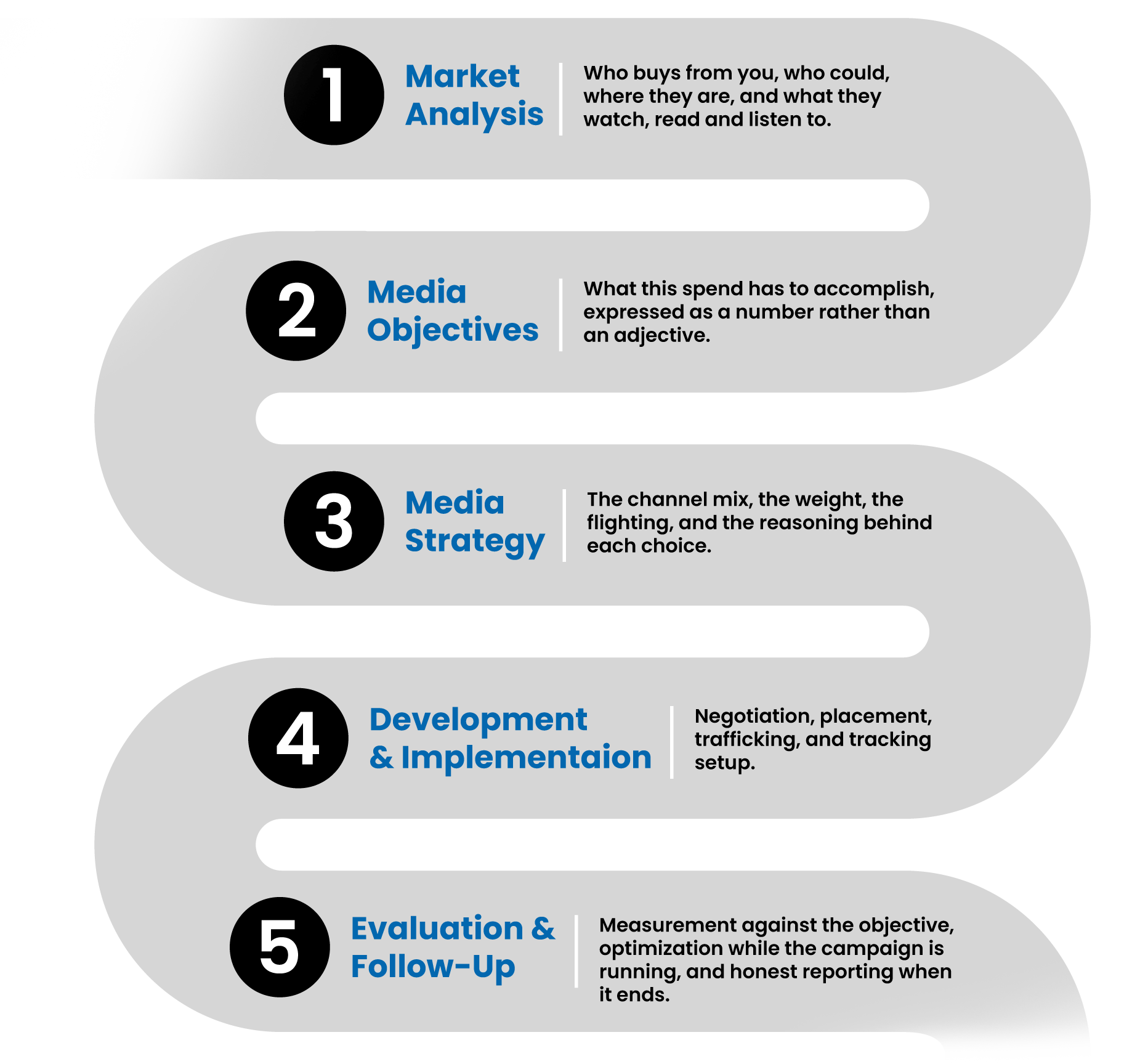
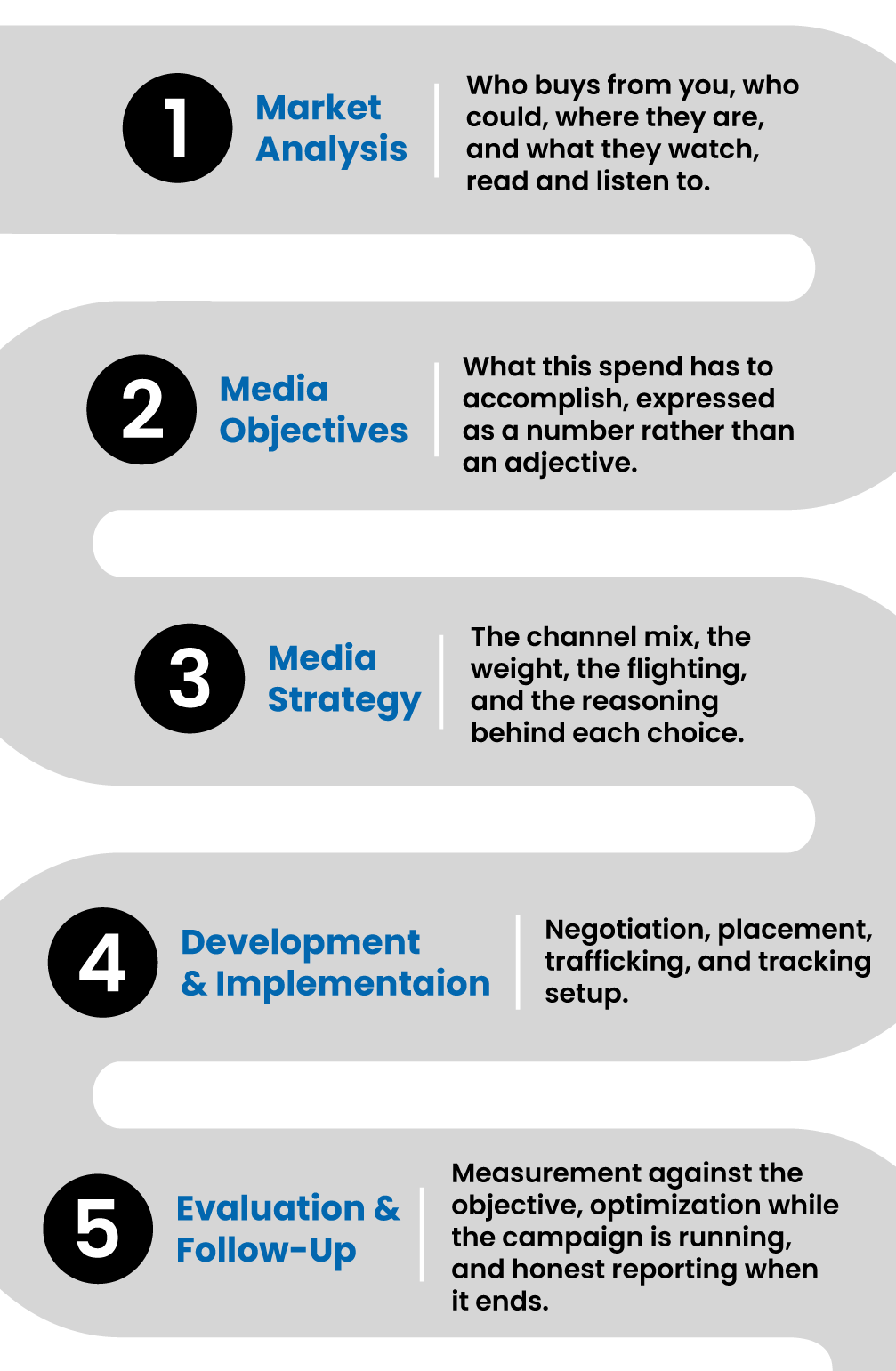
The process runs in five stages:

The process runs in five stages: • Market analysis. Who buys from you, who could, where they are, and what they watch, read and listen to. • Media objectives. What this spend has to accomplish, expressed as a number rather than an adjective. • Media strategy. The channel mix, the weight, the flighting, and the reasoning behind each choice. • Development and implementation. Negotiation, placement, trafficking, and tracking setup. • Evaluation and follow-up. Measurement against the objective, optimization while the campaign is running, and honest reporting when it ends.

The two halves are inseparable. A brilliant plan bought badly wastes money. A sharp buy against the wrong plan wastes more.

Why you need Media Planning and Buying.

It is hard to know whether your media investment is working. It is harder still to know whether you received what you were promised. And the ground underneath media buying has shifted more in the last three years than in the previous twenty.

  • 2026 is the year streaming passed television. eMarketer projects US connected TV upfront ad spending at $17.73 billion against $16.98 billion for primetime linear — the first time CTV has taken the larger share. The IAB puts digital video at 61% of all TV and video ad spend this year, with linear at 39%.

  • Linear is not dead, but it is no longer the default. Linear television has fallen to roughly 12% of global ad spending. It still does things nothing else does — live sport, mass simultaneous reach, local news credibility — but buying it out of habit is now an expensive habit.

  • Fragmentation has made planning harder, not easier. Your audience is split across broadcast, cable, half a dozen ad-supported streaming services, YouTube, audio, podcasts, retail media and out-of-home. Reaching them takes a plan. Reaching them efficiently takes a plan and a buyer who knows what each of those placements is actually worth.
  •  

A media plan exists to answer a specific set of questions before your money is committed:

  • Does the media audience genuinely mirror your target customer, or just resemble them?
  • Which channels efficiently cover your geographic market — and how much waste are you paying for outside it?
  • What combination actually delivers against the goal, at each stage of the purchase decision?
  • Does the selection fit the budget, and what does the next dollar buy?
  • Does the placement environment fit the brand and the creative?

Answer those properly and media becomes an investment with a return you can track. Skip them and it becomes an expense you defend annually.

We utilize industry standard information from...

ComScore
Mintel
Nielsen
Polk - S&P Global Mobility

Frequently Asked Questions

What is media planning and buying, and how do they work together?

Media planning defines your target audience, where to reach them, how often they should see your message, and how to allocate your budget across channels. Media buying executes the plan—negotiating rates, purchasing placements, optimizing delivery, and adjusting spend in real time. Together, they ensure your message reaches the right people, in the right place, at the right cost.

How do you determine the right media channels for our campaign?

We analyze your audience’s demographics, interests, media consumption habits, location, and engagement behavior. Based on that data, we choose the most effective channels—such as video, OTT/CTV, display, programmatic, paid social, or audio—to maximize reach, frequency, and conversion efficiency for your objectives.
What is your process for media planning and buying from start to finish?

Our process begins with discovery and audience research. We then build a strategic media plan, negotiate and purchase placements, set up tracking, launch the campaign, and optimize performance throughout its duration. Finally, we deliver clear reporting tied to business outcomes like leads, sales, and ROI.

What metrics and KPIs do you use to measure media performance?

We track reach, frequency, CPM, CPCV, CPL, viewability, engagement, and conversion attribution. Our reporting connects your media investment to measurable outcomes—showing not just how many people saw your ads, but how those placements impacted leads, pipeline, and revenue.

How do we get started with media planning and buying services?

We begin with a strategy session to understand your goals, budget, audience, and current media mix. From there, we develop a customized media plan, outline performance expectations, and present a timeline. Once aligned, we begin the buying and execution process and keep you updated at each milestone.